
GROUP RAISES MONEY TO BUILD CHILDREN PLAYGROUND
The primary school in Eku, Nigeria has no playground. So children hardly play during school, and they play on the road and in the streets after school. By that they do expose themselves to automobile accidents. “The children and I want to build a playground for the school.” Ruth Akpobome says, “We will plant grass donated by parents in the school’s open space to serve as field for football (soccer). We will also buy and install two goal posts, a 10 seat merry-go-round (carousel), buy five skipping ropes, a whistle, two footballs, and sports kits for 20 kids.”
Once these are donated to the school, children can play in the playground during break time at school. They can also come to play after school hours because the school is not fenced. The project will help the kids find a safe place to play.
The group, the Good Neighbours, are concerned with little works of compassion for those not so privileged. Their works need publicity and support. The group have applied to foreign charity organizations but have not been able to secure fuding. They now seek local funding. According to one member of the group, the funds will cover:
Two goal posts for soccer …………..$95
A ten seat carousel……………………….$550
Five skipping ropes……………………….$8
A whistle………………………………………..$1
Two footballs (soccer balls)………….$6
Sports kits for 20 kids……………………$340
All helps will be acknowledged. The group can be reached on facebook at https://www.facebook.com/goodneighbourhoodinitiative?ref=ts&fref=ts
Last updated May 27, 2015
THE SOCIOLOGY OF LITERATURE: THE PLACE OF URHOBO LITERATURE IN GLOBAL SCHOLARSHIP
Being a Report on the Opening Ceremonies of the Port Harcourt World Book Capital 2014
By Blessing Alex
“Only a generation of readers can span a generation of writers”
- Steven Spielberg, American film director, screenwriter and business magnate.
During the fourth week of April 2014, the ancient city of Port Harcourt in the Niger Delta region of Nigeria hosted diplomats, literary giants, writers, publishers, readers, pupils, artists, and students from across the world in a book festival. The event was meant to last for one full year, but the opening ceremonies held at the Hotel Presidential from April 22nd to 26th, featured exhibition of culture and literature from Nigeria, Thailand, Switzerland, Kenya, France, Czech Republic, and Cote D’Ivoire.
Tagged “The Port Harcourt World Book Capital (PHWBC) 2014”, the events were organized by the Rivers State Government under the auspices of the United Nations Educational, Scientific and Cultural Organization (UNESCO). The programmes were held from 9 am until around 6 pm daily. Activities included exhibitions in the mornings, book reading to children by celebrities in the afternoons, and tours, drama presentations and dinner/cocktail for dignitaries in the evenings.
Each day had a special activity. Monday, April 21st was scheduled for arrivals after the Easter celebrations the previous weekend. The main events began on Tuesday, April 22nd. Tuesday was tagged “Elechi Amadi Day”, in honour of the author of Concubine, Sunset in Biafra, and other works. Governor Rotimi Amaechi of Rivers State opened the International Literature and Culture Exhibition in the morning. This was followed with a public presentation of a book, 100 Years around Port Harcourt (communal stories written by public schools children from around Rivers State on the sights and sounds of their Local Government Areas). In the evening, guests met with Elechi Amadi for a panel discussion and book signing.
The handing over ceremony of “The book” to the City of Port Harcourt by Bangkok, the World Book City (WBC) of 2013 took place on Wednesday April 23rd, which was also UN Copyright Day. The Ceremony was chaired by Former President, Abdusalami Abubakar. Keynote address was given by Nobel Laureate, Professor Wole Soyinka, and series of Speeches by several dignitaries followed. Shortly before the actual handing over of the WBC, a team of poets, dancers, and dramatists performed before the audience.
The followings are excerpts from the speakers at the Wednesday event tagged “Wole Soyinka Day”.
- Abdusalami Abubakar. He praised the Rivers State Government for its improved development of government schools, adding that Port Harcourt, over the few years, have become a haven for book lovers. Thus the UNESCO title “is a fitting reward for Port Harcourt.” The former President concluded with a stirring note, saying, “if there is no peace, there will be no time to read all these books… if there is no peace there will be no country.”
- Goodluck Jonathan, represented by his Special Assistant on Documentation, Mrs Molara Woods, praised the programme and called to all to “elevate our reading culture”. He also reiterated the presidential “Bring Back the Book” campaign.
- In her good will message, the director-general of UNESCO, Ms. Irina Bokava noted that the power of books “to advance individual fulfilment and to create social change is unequalled,” adding that the “history of the written word is the history of humanity.” The UNESCO Country representative, represented by Prince James noted that “2014 will be devoted to the power of books.”
- Oby Ezekwesili. One of the key figures whose activities, over the years, led to the success in hosting the WBC was Dr. Oby Ezekwesili, chairperson of the trusties of Rainbow Book Club, Port Harcourt. In her speech, she opined that reading “decelerates the aging process” and that “anyone who reads a book will lead society.”
- Koko Kalango is the Project Director for the Port Harcourt World Book Capital. Her presence was felt almost everywhere during the opening ceremonies. She said that the programmes “have the potential to transform the educational landscape of the continent, beginning…in the city of Port Harcourt.” She added thus: “the book is a powerful tool for change, a means to an end. That end should be a peaceful society which grooms enlightened and empowered individuals, families and nations.”
- Rotimi Amaechi. The Rivers State governor emphasised the need for reading and education. In contrast to political governance, he noted that “an academic is bigger and greater than the governor…to be a governor you just belong to the right party…to become a professor you must burn your candle.”
- Wole Soyinka. The Keynote Address was given by Professor Wole Soyinka. In his opening speech, he called on the President not to “re-imposed tax on books”. He titled his speech, “Republic of the Mind and Thraldom of fear”, using it to address the security and political situation of the country. He said that “the bookfair is a rejection of Boko Haram fatwa,” also noting that the battle that Nigeria is facing is beyond the physical. “We are engaged in a battle of the mind, which is where it all begins, and where it will eventually end.”
The World Book Capital
The World Book Capital (WBC) was initiated by UNESCO in 2001 as a title to be bestowed to a city in recognition of its quality of programmes dedicated to the promotion of book and reading. The programme originated from the success achieved in the launching of the 1996 World Book and Copyright Day.
For the first three years, cities were selected by the Selection Committee. Madrid, Spain (2001), Alexandria, Egypt (2002) and New Delphi, India (2003) held the title through selection. But since 2004, nomination has been by a public call for candidature.
Port Harcourt was nominated The World Book Capital 2014 by the Selection Committee made up of representatives from UNESCO, the International Publishers Association, the International Federation of Library Associations and Institutions, and the International Booksellers Association. According to the Committee, “Port Harcourt was nominated World Book Capital 2014 on account of the quality of its programmes, in particular its focus on youth and the impart it would have on improving Nigeria’s culture of books, reading, writing and publishing to improve literacy rate.” Cities that bided for the 2014 place with Port-Harcourt were Ganja (Azerbaidjan), Icheon (Republic of Korea) Lyon (France), Moscow (Russian Federation), Oxford (United Kingdom), Pula (Croatia), Sharjah (United Arab Emirates), Vilnius (Lithuania), and Younde (Cameroon).
The Sociology of Literature
Elechi Amadi admitted that various writers write with various objectives. He, however, pointed out that creative writing was originally meant to entertain readers, to set them free from boredom and troubles of everyday life. He advised that commentaries on political and security situations of a society should best be addressed by journalist and political analyst, not novelists. This argument raises the question of the role of literature in society. Since it is not the scope of this article to discuss the broad role of literature generally in society, an attempt shall be made to look at the role of Urhobo literature in society and their place in the all-year long book festival at the 2014 World Book Capital.
Literally activities will continue in Port-Harcourt until the WBC title will be handed over to the 2015 host in April 2015. The annual Port Harcourt book festival to be organized for a whole week in October (20th -25th), 2014 will feature a book fair, writers workshop, symposia, meet-the-authors section, amongst other events. This is an opportunity for scholars, writers, publishers and independent researchers with interest in Urhobo studies to exhibit literary genius of interest to the Urhobo nation.
Looking at the level of decline in the traditional annual festivals of Urhobo communities, one could feel that the trend is irreversible. It is the opinion of this writer that due to religious pluralism and growing influence of Christianity in Urhobo land, it would almost be impossible to revive the communal annual festivals of Urhobo communities. Therefore, suggesting a substitute that will be acceptable to people of all faith in the land should not be out of place.
On that note, it would be rewarding for the Urhobo community to start an annual literary festival in which our language, history and culture will be showcased, void of all religious controversies. We learned that the ancient Olympic games were stopped for almost 15 centuries for religious reasons. However, since their revival on secular ground, talents from all works of life continue to be publicised. If it is agreed that there is a need for the inauguration of an Urhobo Annual Literary Festival through which a literary exhibition of our history, culture and language should take place, then the UNESCO/Port-Harcourt Book Festivals should be case studies or launching pads for the Urhobo Project. This writer believes that this was what was in the mind of Godini G. Darah, professor of oral literature in Africa, when he sponsored the trip and participation of the writer to the Port Harcourt World Book Capital.
The presidency calls for all and sundry to “Bring Back the Book”. And the Port-Harcourt World Book Capital’s theme is “Books: Windows to our World of Possibilities”. There are hitherto untapped resources in and about Urhobo that wait for literary excavation. The documentation of our languages (Okpe, Urhobo and Uvwie) and dialects, history and culture will not only entertain and inform the present generation, but also preserve the posterity of the institutions or structures upon which we stand. And until enough books in Urhobo Studies are written, printed and published, the window to the Urhobo worldviews and possibilities cannot be opened to our future generations or to the outside world.
This calls for new writers in Urhobo studies to unsheathe their literary pens and for old ones to sharpen their swords which have become blunt out of un-use or use in other realms. If there are no writers there will be no books, and if there are no books there can be no readers.
Bibliography
Kalango, Koko and Titi Horsfall (eds) 100 Years Around Port-Harcourt. Port- Harcourt: Rainbow Publishers 2014.
Port-Harcourt World Book Capital 2014: Opening Ceremonies Programme.
Port-Harcourt World Book Capital 2014 Programmes (Leaflet).
“World Book Capital”. en.wikipedia.org/wiki/World_Book_Capital
“World Book Capital”. https://en.unesco.org/world-book-capital-city
www.port-harcourtworldbookcapital.org
SPACE AND TRAVEL CLUB EXPEDITION 2014 and 2015
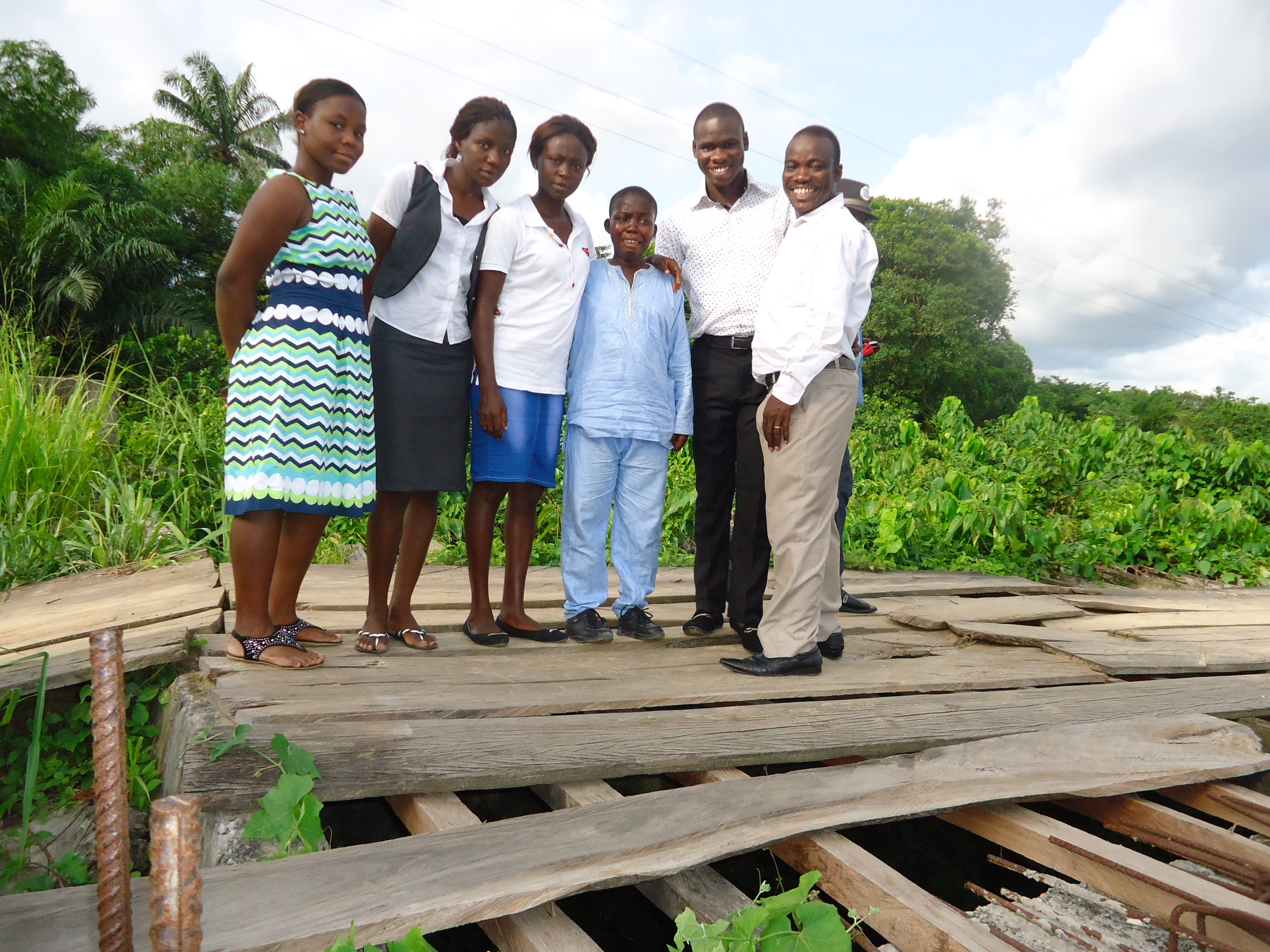
Team members of the Space and Travel Club, along with solidarity members travelled around Urhobo-land on a two day expedition. Led by Akpobọmẹ Diffrẹ-Odiete, the team reached or crossed twenty-six towns and villages in nine kingdoms in a total of about ten hours of travel. Other members of the travel crew were Augustine “Popo” Omohwo and Oghenenyerhovwo Odogun. These, with the team leader, are recent graduates from the Urhobo Unit of the Department of Languages and Linguistics, Delta State University, Abraka, Nigeria. Solidarity members who joined the trip were Gift Onohwo, a recent graduate from the Physical and Health Education Department of Delta State University, Abraka; Blessing Obatare, a Business Education undergraduate student of Delta State University Extension programme at College of Education, Warri; and Akpobọmẹ Diffrẹ-Odiete, Jnr. of Delta Secondary School, Warri.
The Space and Travel Club was inaugurated in April 2013 by Professor G.G. Darah of Delta State University, Abraka, Nigeria. Last year, seven team members visited eleven Urhobo Kingdoms and some neighbouring Ijaw communities in Bomadi Local Government Area of Delta State in southern Nigeria.
The plan for this year’s adventure travel was to go out for three days (April 11-13). However, a government public announcement limiting travel on April 12 as a result of urban environmental sanitation obstructed the plan. The journey was therefore made on Sunday April 12th and Monday 13th.
4:00 – 9:00pm; Sunday April 13th, 2014.
Fully funded by the patron, Professor G.G. Darah, the journey began at about 4p.m on Sunday April 12th after church worship. The Patron had bid the travellers Godspeed saying, “Ovwan yan eghwere”, meaning “may you go well”. Except for Oghenenyerhovwo, all of the adventurers took off from Ugboroke in Uvwiẹ Kingdom. Popo had come in from Urhiapẹlẹ (Sapele) about an hour prior to take off. Passing through Okuọkọkọ in Okpẹ kingdom, Agharho and Eruemukohwarien (Ughele), the team got to Ekiugbo-Ughele where Oghenenyerhovwo joined the crew. The explorers then turned around, and passing through Ighwremaro (Ughele), came to Ephron-otọ.
Ephron-otọ is the smallest of the twenty-four Kingdoms of the Urhobo people. The village-kingdom is surrounded by Urhobo towns and villages of other dialect-speaking people. According to Olorogun Akporido Wilson Coker, a native Chief, only three natives can speak Uvwiẹ fluently, out of about 1,200 inhabitants. This is as a result of dialectal contact. Olorogun Coker had been a local contact and native-speaker consultant for the team members for four years. He was called on phone before the team arrived to meet a hospitable welcome as the Chief organized a traditional welcome for them. The team then proceeded to the uncompleted Ephron-otọ-to-ovwor bridge.
Leaving Ephron-otọ, the team went to Ogoni-Olomu where they visited the old Mosheshe house that lay opposite the palace of the Ohworode of Olomu. The Mosheshe House now houses the Global Maritime Academy. This part of the journey would have been easier and shorter if the bridge from Ephron-otọ to Ovwor were motorable. However, the team had to go back through Ekiugbo, Ughele, and Oteri to Ogoni.
After a few minutes stay at Ogoni, the journey took the crew to Eghwu through Ughele, Otogọ, and Edjekota. At Eghwu, the crew visited the ‘The Little House of No Regrets’, the compound of Olorogun Odiete Diariarijere (d.1959), one-time councillor, strong member of the then N.C.N.C and social democrat who brought a Postal Agency, a primary school and a Maternity Home for his people.
Leaving Eghwu late in the evening, the crew returned to Effurun where they visited A.J Eatery and Chicken Republic to celebrate the birthday of Blessing Obatare, one of the solidarity members of the club. The day’s journey came to an end at 9p.m
10:00a.m-3:49p.m; Monday April 14, 2014
The journey of the next day covered more kingdoms and more towns, but with a fewer crew members. Since this day was a normal working weekday, only two members of the crew, Augustine Omohwo and Akpobọmẹ Diffrẹ-Odiete were available. They took off from Ugboroke in Uvwiẹ Kingdom, visiting or passing through some eighteen towns and villages in five kingdoms. They reached Unenurhie in Evwreni where they had a chat with Pa Julius Arerierian, a veteran teacher at the Department of Languages and Linguistics, Delta State University, Abraka.
When they left Evwreni, they followed the same road back and came to Agharho, the central town where there are immigrant communities from various Urhobo Kingdoms-Ikueghwu (from Eghwu) Ighwrughele (from Ughele) and others. April 13th (the previous day happened to be the first anniversary of the dearth of Augustine Omohwo’s father, so the team members stopped to see the widow (Austin’s mother) at Agbarho too).
The journey from Agbarho took the team through Ughwaghwa, Adagbrasa, Ibada Elume, and Amukpe to Sapele where the two-man team had lunch before they parted. Austin remained behind after a sight-seeing of the houses of famous men such as Patrick Aziza, the President-General of Urhobo Progress Union, and Charles Obule. Akpobọmẹ, now a lone rider, reached home at Ugboroke, Effurun at 3:49pm. In all, over twenty-six towns and villages were reached in nine Kingdoms in a journey of about ten hours ride in a Toyota Previer car. Last year, the Patron, Professor G. G. Darah had received the adventurers back home with a message: “[T]he harder the experience, the deeper the knowledge.” On their return this time, he hailed them with a text message, “Excellent Adventure”!
The journey was practically very educative. Most members of the team reached the areas visited for the first time in their lives. The experience also added value to the members’ spirit of space and travel adventure.
Acknowledgement
We give God all the glory and honour for safety, protection and good health during the adventure. We also thank our Patron, Professor G.G. Darah for his financial and moral support.
2015 EXPEDITION
This year, preparations are on ground to visit historical sites of Urhobo land. We will keep you posted.
 EDOID CULTURAL HERITAGE ENTERPRISE
Leave a comment